

The Power of Setting in Dark Romance

There’s a moment before every scene when I feel the air first. The weight of it tells me what kind of story I’m about to tell. Some nights hum, city lights flickering like promises half kept. Others hold their breath, that quiet before something breaks. Setting, for me, is never decoration. It’s instinct. It decides whether the reader leans forward or pulls back. I use it to seduce, to soften, to lie.
When I started writing dark romance, I didn’t realize how much the setting would carry the emotional weight of a scene. It’s not just the city or the room. It’s how those spaces breathe around the characters. A hallway can feel like a threat. A kitchen can turn into a confession booth. A bed can be both sanctuary and weapon. The world bends to match what’s happening between two people, and if I’ve done it right, the reader feels it before they can name it.
When I build atmosphere, I think about contrast. Light against dark. Soft against sharp. Silence against sound. Every detail has a job. The sound of heels on tile can mean dominance or vulnerability. The smell of rain on concrete can foreshadow a storm in the story long before the characters see it coming. I let the setting move like a third presence in the room. It listens, reacts, and sometimes betrays what the characters are trying to hide.
Readers may not realize it, but setting teaches their bodies how to feel. Before a single line of dialogue, the tone of the space tells them if they’re safe, aroused, or on edge. That’s what I love about writing in the dark. I can play with that tension, build trust, then twist it. A warm apartment can become a trap. Candlelight can shift from intimacy to interrogation. The setting controls how quickly the heart beats, even when the mind hasn’t caught up yet.
The fun part is control. I don’t mean control in the obvious sense, like plotting a twist or deciding who survives a chapter. I mean control over what the reader feels without them realizing why. That’s the real craft. Setting lets me play with emotional rhythm. I can warm a scene, then pull the rug out from under it. A tender moment might unfold in golden light, then shift when that light flickers or dies. The smallest sensory change can make the heart stumble. I love the tension of contrast, how beauty and unease can exist in the same breath.
It’s a quiet form of manipulation, but an honest one. Readers enter a story with their senses open. They’re not aware of how quickly the mind starts searching for safety, for something familiar to hold onto. When that comfort appears, the body relaxes. The heartbeat slows. That’s when I make my move. The mind trusts what feels familiar, and I twist that trust into something unsettling. It’s what makes dark romance so intimate. The reader experiences danger the same way the characters do, through subtle changes in temperature, sound, or space.
I think of it like body language. Just as people signal emotion through posture or tone, stories do it through setting. When I write, I’m not just describing a place. I’m describing the body of the story itself, its pulse, its tension, its scent. The reader feels that body pressing closer before they consciously register why. That’s how I know the atmosphere is working.
A dark romance thrives on that tension. If everything feels heavy, the story loses bite. If it’s all softness, the story loses danger. The power sits in the edge where the two meet. Sometimes I’ll build a setting that feels safe, even romantic, just to make the reader let their guard down. Then I break it. I love that gasp that happens when comfort becomes threat. That’s when they know they’ve given me their trust, and I’ve used it.
When I think about how setting shapes a character, I see it as an invisible hand guiding their body. People behave differently depending on the walls around them. A woman might hold her breath in a man’s apartment, not because he asked her to, but because the room itself hums with his presence. A character who feels free in sunlight might fold into herself under fluorescent light. Setting teaches posture before dialogue ever begins.
I pay close attention to how a space forces honesty or repression. Confessions rarely happen in open fields. They happen in kitchens after midnight, or hallways where someone’s too close to walk away. The body knows when a room demands surrender. And that’s the moment I write toward, the place where setting becomes a mirror, showing the reader what the character can’t yet admit.
Silence is just as powerful as detail. Sometimes I build a room by what isn’t described. The absence of sound, the empty corner, the untouched glass on a table. Those quiet choices leave space for tension to grow. Readers fill in the silence with their own unease, and that’s when the story starts breathing on its own.
Restraint is a discipline. I used to overwrite, painting every wall until nothing could move. Now I try to leave air between the words. If I describe too much, the reader stops imagining. If I describe too little, the scene loses gravity. The right balance makes the world feel alive, not staged. It feels like the camera could pan a little further and reveal something I never said aloud. That’s the kind of mystery I want to keep.
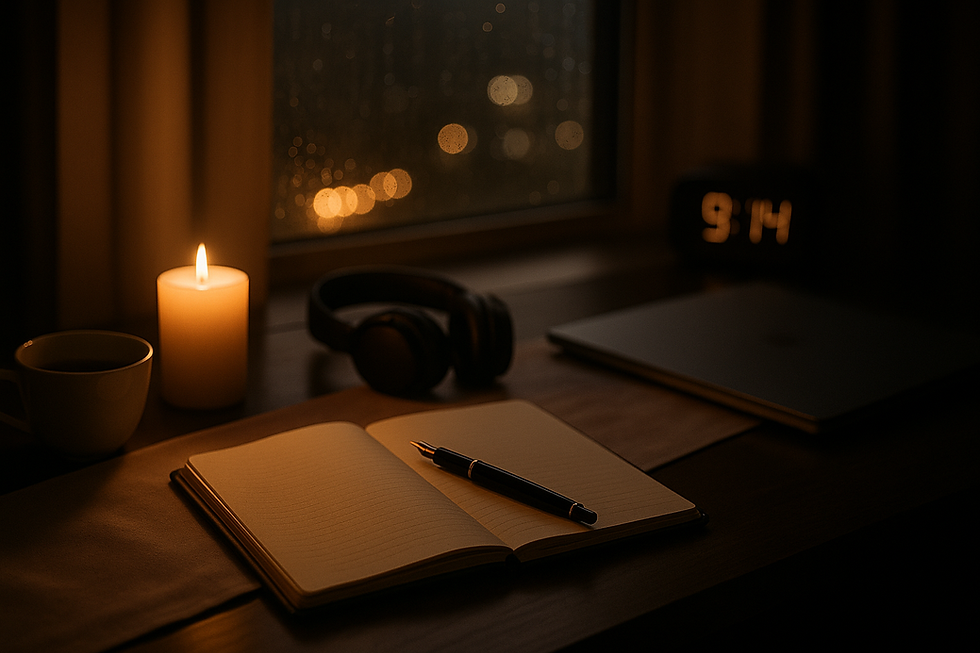
My process changes depending on the night. Sometimes a candle is lit, the fireplace flickers on the TV, and the room feels like velvet. The laptop is open, R&B or jazz playing low, a glass of wine within reach. Those are the slow nights, when I want to savor the world I’m building. Other times, I’m half asleep in my bedroom, scrolling through Instagram, and one image or caption sparks something that won’t let me rest. I’ll open my Notes app and start writing right there, caught between dreaming and thinking.
There are also nights when I’m on a group chat or a call, quiet in the background while everyone talks over each other. They think I’m gaming or working, but I’m writing. The noise fades, and I slip into focus. It’s chaos outside, calm inside. I’ve learned to trust those moments because they remind me that inspiration doesn’t always arrive dressed in ritual. Sometimes it just finds me when I’m still enough to listen.
The settings I write come from everywhere. Some are moments I’ve lived or stories I’ve been told. Some are how I wish a scene would play out. Some belong to places I’ve never been but ache to experience. Others exist only in my imagination, the rooms I wish the world had made for me. They all feel real once they touch the page.
Setting, for me, is the unseen character that stays long after the scene fades. Readers might forget what someone was wearing or even what was said, but they remember how the room felt. The warmth. The chill. The pulse. Every story lives somewhere, and that place shapes everything that happens inside it.
When I think about the settings I’ve written, the apartments, hotels, city streets, bedrooms, they all hold pieces of me. They’re not just where the characters fall, fight, or surrender. They’re the proof that emotion needs a body to live in. That’s what I love most about writing dark romance. The setting seduces too. It’s the first touch before any touch at all.


Comments